
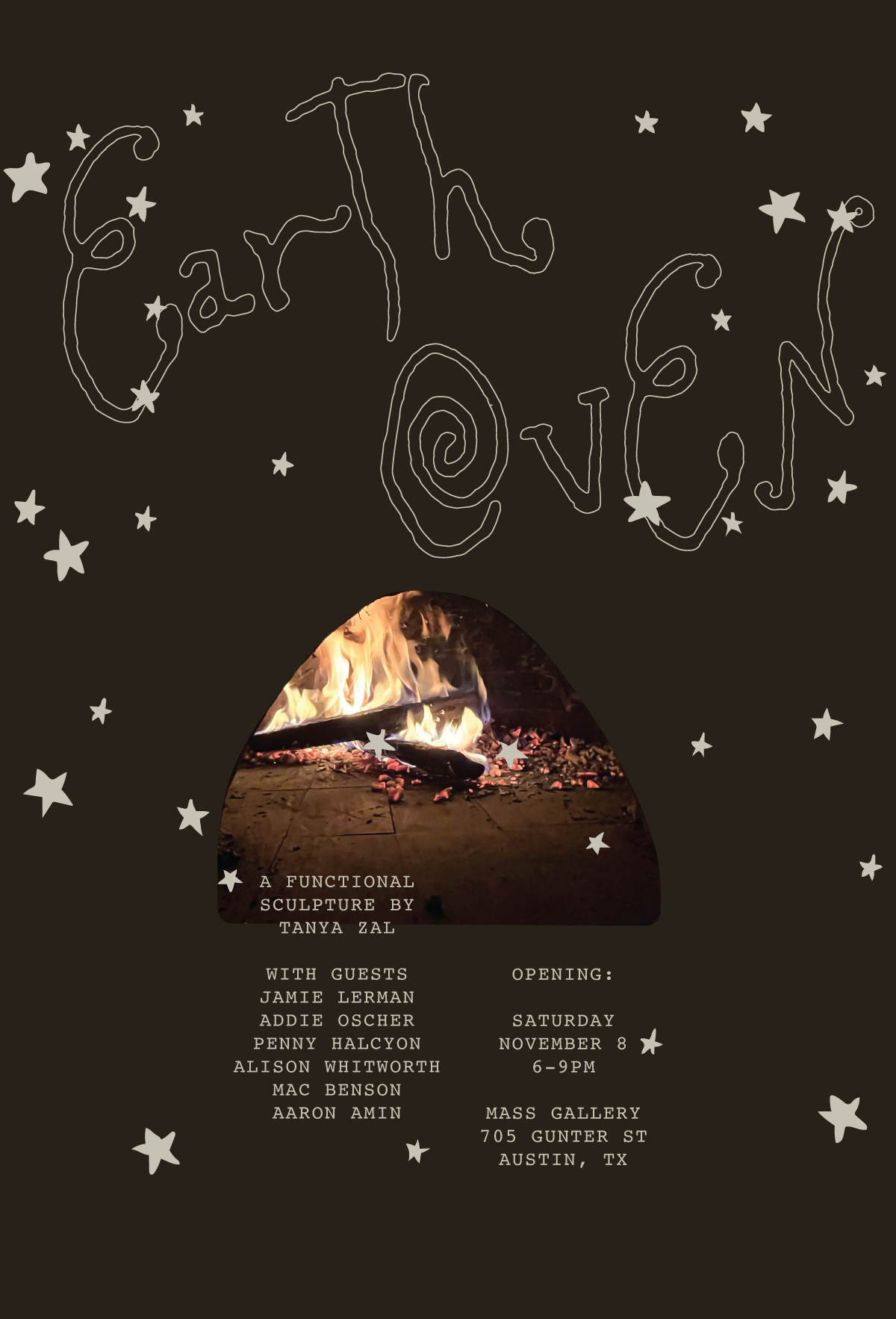
Earth Oven
Completed in 2026, the Earth Oven is a communal, functional sculpture project led by Tanya Zal grounded in the practice of hand-building and created in collaboration with the help of many, including Alison Whitworth, Addie Oscher, Aaron Amin, Jamie Lerman, Mac Benson, and Penny Halcyon.
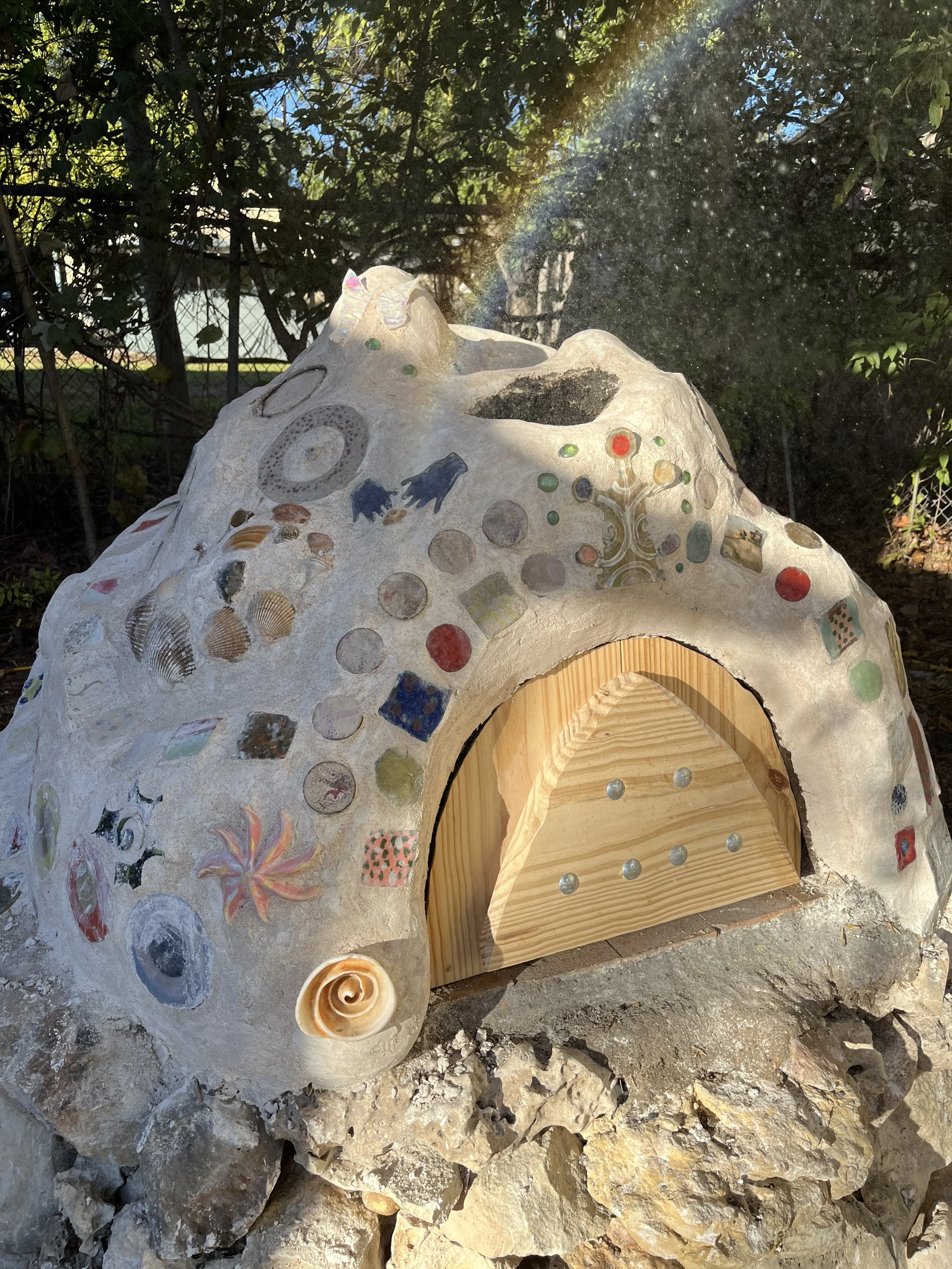
Using natural building techniques we created a cob oven using locally sourced materials- limestone, soil, sand, and straw. It's decorated with recycled ceramic pieces made during our summer Clay ReWork-Shop, where we reimagined broken bisque and glaze ware into tile and mosaic. The oven will be a permanent part of MASS Gallery and a space for sharing food and community on a regular basis.
“If you build it, they will come”
Text by Maggie Mitts
Not unlike conjuring a baseball field from dreams—a site built out of earth beckoning locals to gather and cavort—human beings have been called to build communal spaces out of earth for millennia. While this line invokes a different ghostly presence, Tanya Zal, a sort of choreographing ceramicist, explains “big clay” similarly beckoning her to gather people and materials to build the earth oven—a communal, functional sculpture project led by Zal, and grounded in the practice of hand-building. This project emerged with the help of many hands, including Alison Whitworth (graphic design, fabrication), Addie Oscher (of Time Being Books), Aaron Amin (pizza), Jamie Lerman (mosaic, tile), Mac Benson (zine), and Penny Halcyon (photo/video). Thank you to the ensemble build crew who showed up to give hands-on support: Abbey Weber, Alexis Hunter, Amanda Vaughn, Ani Bradberry, Anne Chen, Ariel Wood, Camila Restrepo, Carmen Rangel, Caroline Dunn, Clayton Cain, Emily Meeks, Ian McDowell, Katherine Lain, Leah Danze, Leika Aguinaldo, Maddie Mondshine, Paloma Mayorga, Phoebe Schuman-Goodier, Sabine Fletcher, Samantha Melomo, Sofie Cardinal, Sophia Hatzikos, Terri Mashburn, Tova Katzman, and Travis Byargeon. Together, the builders welcome visitors to celebrate the end of the building phase, culminating in an oven, and the beginning of the hearth phase, marked by the oven’s warmth, food, and a gathering to enjoy each other’s company.
Zal and her cohort created the earth oven according to the cob building technique, whose name brings to mind “to cobble together”—to roughly assemble or put something together from available parts or elements. As its name suggests, cob building is a process born of resourcefulness: the builders used their unique and varied skills to combine what was at hand to create the thing they could, having a conversation of give and take with materials that respond, have been around, and—thankfully, strangely, rightly—will be here long after we are gone. Toward the spirit of sustainability, and considering time cycles that extend beyond our own, Zal and fellow hand builder Lerman held a “clay rework-shop” to transform abandoned leftover bisqueware (half-made ceramics) into tiles to adorn the outside of the oven: their playful, organic forms suggest the mass of hands that contributed to its building.
Though the term cob is an english word dating to the 1600s, the practice of building with earth can be traced back at least four thousand years to Iran, and has since seeped into Indigenous cultures across the world. Here in Texas, recent and historical locals may be familiar with adobe, our local form of earth-building related to cob. People have combined heat and earth to sustain themselves with food and warmth for too long to tell; like working with earth, the oven transcends borders, eras, and climates. The builders coaxed local limestone, soil, sand, and straw into that quintessential form that summons people to gather round: a hearth.